Foil stamping is good for packaging improvement, but it gives you poor results with extra cost if you are using the wrong method, material, or artwork.
In this article, you will learn about the process, prepare artwork, compare foil methods, and control costs. It tells you how you can prevent some major or common problems before production.
What Is Foil Stamping?
Stamping without covering the entire package, you can use it easily for various treatments related to the surface.
The result that you get at the end depends on various things, such as packaging surface, foil type, artwork, and the settings of production. The above factors I have mentioned affect the transfer quality, detail, overall appearance, and adhesion.

How Does Foil Stamping Work?
The main process of foil stamping changes all methods like hot, cold, and digital methods, but you have to know that every method transfers it to only your chosen artwork.
1. Prepare Your Artwork
Try to keep every colour of foil on a different or separate layer by starting with the final packaging dieline.
Use different names for every different layer, like “Gold Foil’’ and keep your text small, thin lines, and make narrow gaps simpler.
2. Prepare The Transfer Area
The method of hot foil requires a metal die for your artwork. So, you have to raise the areas where you want to die and press the foil onto the package.
The method of cold foil always uses printed adhesive. But the digital foil varnish, toner, and digital bonding layer.
A second foil requires more than one setup or pass, and due to this, cost and production will increase.
3. Position The Material
Your foil carrier always runs between the things like the transfer system and surface, but your suppliers have the responsibility to fix the packaging material in a controlled position.
Graphics, cut lines, folds, borders, and product names always use right registration to keep your foil in line.
4. Transfer The Foil
You have to use heat and pressure for hot foil, and the die touches where the decorative bonds touch.
The cold foil used for printing adhesive applies foil, cures or manages the bond, and you can also use it for removing the carrier.
In digital imaging, you can not use any traditional metal die for creating the bonding image. This tool is only used for transferring foil onto the image where you want foil.
5. Inspect A Physical Sample
You can examine thin lines, folds, seams, and curved areas by checking the sharpness, position, shine, adhesion, and colour.
A screen proof can’t show you the actual texture, reflection, or the bond strength by approving a sample that you are using for your final material.
Four Types of Foil Stamping
You can definitely apply your best method to surface, finish, production speed, network, and available equipment.
| Method | How It Works | Best Fit | Main Trade-Off |
| Hot Foil | A heated die in hot foil transfers foil with pressure | Fixed designs, repeat orders, tactile finishes | You have to pay for tooling and setup |
| Cold Foil | It prints adhesive bonds foil during printing | Fine detail, larger areas, longer runs | A smooth surface is usually needed by you |
| Digital Foil | Image receives foil in digital bonding | Prototypes, short runs, variable designs | The finish lines are not clean or well pressed |
| Foil Embossing | Foil will be combined with a raised impression | Premium logos and focal details | Accurate registration is needed by you |
The hot, cold, and digital options compare the Foil and Specialty Effects Association’s foil guide.

Hot Foil Stamping
For a pressed appearance, dense metallic colour, and crisp edges, you can use the method of hot foil.
You can reuse your die when your artwork remains the same after repeating orders, but the die production and setup are included in your first order.
Cold Foil Stamping
For fine detail and larger smooth areas, you have to choose cold foil always.
Your coating and surface need right adhesion, but your provider prints adhesive, cures the bond, and applies foil.
Digital Foil
For changing names and codes, you can use or choose the digital foil method for prototypes, short runs, or designs.
The shine and depth of digital foil are different from hot foil, and in this you can also avoid the traditional die.
Foil Embossing
If you want a raised texture and metallic colour together, choose foil embossing.
Careful artwork and registration need fine details, and for clear or clean results, use Bold logos and simple shapes.
Materials Suitable for Foil Stamping
Your selected method affects foil transfer more than your packaging surface.
In solid areas, rough kraft paper may create small gaps, and the sharper edges usually provide smooth coated paperboard.
Metallic shine with less solid colour provides you with the pigment foil, and the strong reflection always creates the metallic foil.
| Packaging Surface | Result You May Get | What You Need To Check |
| Smooth coated paperboard | It has Sharp edges with an even shine | Coating adhesion |
| White paperboard | You can see Clean colour and contrast in it | Surface consistency |
| Kraft paper | Natural texture with metallic contrast will appear here | Patchy transfer |
| Laminated board | Bright and smooth foil will be shown | Bonding to the laminate |
| Heavily textured stock | A tactile appearance is happening | Missing foil in low areas |
| Heat-sensitive material | A Possible surface distortion is shown | Cold or digital alternatives |
Compare foil performance on the ice cream paper cup material for frozen products.
Applications Of Foil Stamping In Food Packaging
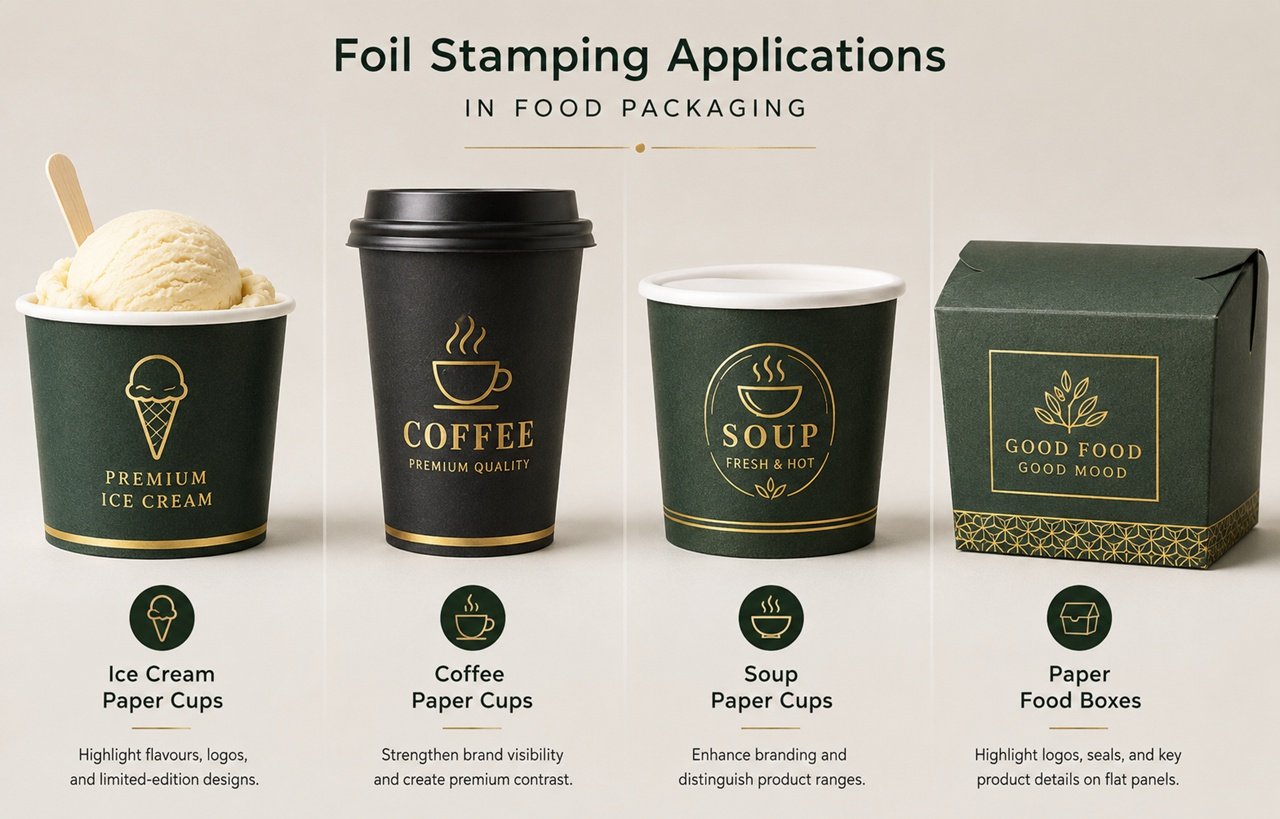
Without covering the whole design, foil stamping helps in selecting the details of packaging. You can also highlight the limited edition messages, logos, product names, borders, and seals.
It is used for supporting a brand presentation more clearly and for adding contrast on matte or dark packaging. You see that the surface and the handling conditions suit it in every foil area.
Ice Cream Paper Cups
For highlighting your logo, flavour name, or limited-edition design, you may use foil on ice cream paper cups.For identifying flavours and product ranges more quickly, this placement is very helpful. The finish is affected by the forming, condensation, and repeated handling, so try to keep the rims and seams away from the foil.
Coffee Paper Cups
To strengthen logo visibility on the main display area, you can use foil on coffee paper cups. A focused foil detail can create stronger differences on dark, neutral, or matte cup designs. Before approving production, always check heat, grip, stacking, and coating compatibility.
Soup Paper Cups
For external logos, borders, or product names, you can use foil on soup paper cups. You have to keep foil away from seams and rims. This treatment can be very helpful in strengthening branding and distinguishing product ranges. You have to test oils, lids, transport, moisture and heat. These checks are necessary for revealing weak adhesion before production.
Paper Food Boxes
To highlight logos, seals, or key product details, you can use foil on flat panels of paper food boxes. Use flat areas, preferably, as it usually provides more control than corners, folds, or curved sections. Movement in these areas can ruin the finish coating, so you have to keep the foil away from glue zones and fold lines.
To check for cracking or registration problems, you can test the finished box after folding, stacking, filling, and delivery. You still need readable information, suitable contrast, and clear hierarchy as foil cannot correct weak packaging design.
How Should You Prepare Foil Artwork?
Start with the real packaging template. Final cuts, folds, glue areas, seams, and safe zones are the things that your designer needs.
Use different foil colors for different layers and keep the elements of foil as vector shapes.
The standard hot foil artwork uses solid shapes, and you can select the method that supports them unless you avoid gradients.
Simplify the narrow gaps, thin strokes, and tiny letters, and use curves on your bowls and cups.
The limits, like minimum line thickness, text size, registration tolerance, and safe distances, depend on your equipment and material.
On the intended stock, approve the physical sample. Samples, printing, lead times, and ordering are explained on Haokelao’s FAQ page.
Which Problems Can Affect The Finish?
Your production settings, materials, surfaces, and mismatched artwork always create most foil problems.
Patchy Transfer
Gaps are always caused by weak coating compatibility, and your surface is mostly rough, or pressure is uneven when you see patchy transfer.
You can ask your provider for testing pressure and foil selection, and always use textured stock for smaller solid areas.
Blurred Details
You have to close narrow spaces. When you see the heat, pressure, or dwell time becomes excessive, you have to spread fine lines.
Used a physical test for approving complex artwork and must use more spacing around tiny details.
Cracking And Peeling
If your adhesion is weak, then peeling will occur. Deep fold is crossed when foil may crack.
You must review the dieline first, which is final, and keep details away from folds, glue flaps, seams, rims, and cut lines.
Misregistration
Around thin borders or small text, misregistration becomes more visible. In this process, foil is placed away from printed artwork.
The intended production setup is used for checking registration on samples. Where you see possibility, use wider tolerances.
Your finish requires a complete packaging journey, and you can also test filling, stacking, freezing, heating, shipping, and handling.
Foil Stamping Vs Embossing, Spot UV, And Metallic Ink
Every finish used for solving different design problems.
| Finish | What You See | What You Feel | Best Use |
| Foil stamping | Bright metallic or solid colour will be seen | Flat or lightly pressed in viewing | Logos, names, borders, seals |
| Embossing | Light and shadow appear | It’s like a raised surface | Texture and subtle marks |
| Debossing | A recessed detail will be shown in it | Indented surface is shown | Tactile logos |
| Spot UV | You can select glossy contrast | Smooth or slightly raised | Images and gloss highlights |
| Metallic ink | A softer metallic effect appears | A flat surface will be seen | Larger printed areas |
When you see that the texture matters more than the colour, choose embossing, and for strong reflection, always choose foil.
If you want wider coverage with softer reflection, choose metallic ink, and for gloss against matte print, choose spot UV.
Every addition affects the setup and registration by combining finishes, and you have to give every effect one clear purpose.
Frequently Asked Questions
What Is The Difference Between Hot And Cold Foil?
There is a huge difference between the hot and cold foil. In Hot foil, you have to use a heated die and pressure, and in cold foil, you have to use printed adhesive, pressure, and curing.
The surface, artwork, quantity, finish, and production setup create the best option for you.
Can You Foil Stamp Every Type Of Paper?
You cannot see the same results on every paper because the cleaner details are provided by a smooth-coated board.
Different foil, adjusted settings, smaller solid areas, or simpler artwork are happening due to Rough kraft paper.
Can Foil Stamping Peel Or Crack?
Foil can peel easily if the adhesion is weak, but it will crack when artwork crosses a stressed fold.
Before approving mass production, always test the final material, coating, shape, and production process.
What Affects Foil Stamping Cost?
Your cost for foil stamping depends on various things like: die, foil coverage, artwork detail, material, colours, sampling, finishing steps, and the order quantity.
Setup expenses are spread across more packages because the unit cost is reduced due to larger orders. An accurate quote is received by sending your final size, artwork, material, quantity, and delivery needs.
Does Foil Stamping Affect Recyclability?
Before making a recycling chain, you have to assess the complete package.
The final results can be changed by paper, coatings, adhesives, linings, foil coverage, and local recycling systems.
Is Foil Stamping Right For Your Packaging?
When focused detail supports your design and survives normal use, then foil stamping suits your packaging. The artwork, material, quantity, and target market are sent to you through the contact page of Haokelao. Then you can compare the sample, total cost, and expected performance.