If you are going to run an ice cream shop, gelato stall, yoghurt dessert stand or supermarket ice cream counter, you will make the wrong choice of ice cream paper cups. Big cups waste product, small openings cause take-out spills and multiple sizes lead to inventory build-up and higher costs. Paper cup size impacts costs, food preparation, delivery and store image. Here are some tips on choosing the right packaging, controlling costs, customising and sourcing to minimise waste and increase average order value.

1、What are the different sizes of ice cream paper cups ?
Commercial ice cream paper cups are standardised by capacity, in ounces (oz). The usual conversion is 1 oz ≈ 30 ml.
Ice-cream, however, is much denser than water, so you cannot tell how much ice it may hold by the millilitre limit. When buying, also consider the diameter of the top, the diameter and height of the cup. The size of the opening of the cup is as important as fit the lid.
1.1 Mainstream Specifications Comparison Table
| Size classification | capacity | position | Applicable Scenarios |
| Mini sample | 3 ounces (90 ml) | Sample evaluation | New product tasting, children’s free gifts, and store promotion activities |
| Small portion for single serving | 4 ounces (120 ml) | Small portion single ball | Basic items in offline small shops, Italian gelato |
| Standard best-selling items | 5 ounces (150 ml) | Standard single spoon | It is compatible with most stores, including markets and dine-in restaurants. |
| Medium single size | 6 ounces (180 ml) | Sufficient single ball | Food court, affordable soft-serve ice cream stalls |
| Double-ball sundae | 8 ounces (240 ml) | Double-ball dessert | Specialty sundaes, milk tea with ice cream, and takeaway desserts |
| Luxury Sharing Edition | 12 ounces (360ml) | Multi-person, multi-flavor combination | Multi-layered fancy ice cream, 1-2 person sharing pack |
| Family takeaway | 16 ounces (480 ml) | Family Stocking Pack | Restaurant dessert sharing, supermarket frozen food retail |
| Large party capacity | 20-26 ounces (600-780ml) | Group meals | Team building, parties, and exhibition bulk packaging |
1.2 3 oz tasting cup (90 ml)
Specifically designed for new product tastings, promotional giveaways and small sized children’s gifts.
The cups are small, take less space in the warehouse and have the lowest cost per unit. They don’t sell them full price and they’re mainly for getting new customers. Thickened food-grade paper construction ensures they won’t soften or leak in -18 degree Celsius.
1.3 Individual items sold: 4/5/6 ounces (120-180ml)
This is the main specification for high volume sales in stores, and most of the basic offline products are based on this specification.
( 1 ) 4 oz (120ml) Short and wide cup body, easy to scoop, suitable for Italian ice cream with firm texture, small amount of toppings are not easy to spill, mainly small portion and affordable single scoop.
( 2 ) 5 oz (150ml): The standard size in the industry, for soft serve and handmade ice. A single scoop topped with cream and fruit is photogenic and visually appealing, making it the go-to serving for beginners opening a shop.
( 3 ) 6 ounces (180ml) : The more generous portion served in the more affordable stalls and food courts, less likely to spill during short-distance takeout, and very popular with student customers.
1.4 Sundae Topping: 8/12 oz (240-360ml)
Designed for fancy double-ball, multi-topping desserts. Commonly used in high-end dessert shops and takeaway orders.
( 1 ) 8 oz. : Standard double-ball cup, with tall clear dome lid, lots of room for cream, chocolate sauce, nuts and fresh fruit. It has good sealing effect, and is a standard configuration for chain brands.
( 2 ) 12 oz: Deluxe multi-flavor bowl, can hold several scoops of ice cream, milk jelly, cake crumbs and fresh fruit at the same time. The same style as the popular mille-feuille ice cream, suitable for two people to share.1.5 Family/Party Large Size 16/20-26 oz (480-780ml)
The cup body is made of thickened double-layer coating, suitable for sharing by several people and long-term frozen storage.
· 16 oz. paper cups are great for sharing with 2-3 people in the family. They have a sealed flat lid that stops water leaking out when they are put in the freezer. They are very good sellers in neighbourhood stores for takeaway and on the supermarket freezer shelves.
20-26 ounce buckets are high-capacity buckets, specially designed for dispensing ice cream for large groups at team building events, exhibitions and other similar occasions. The buckets can also be imprinted with the store logo.
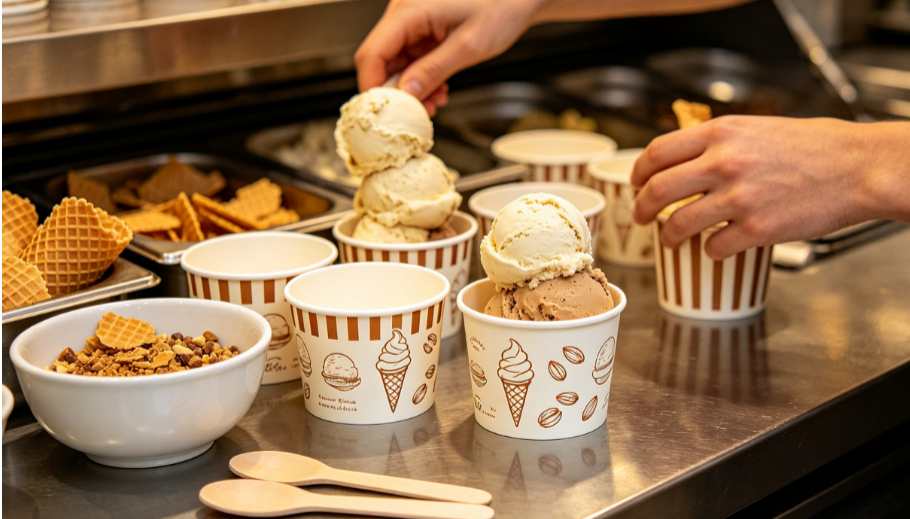
2. How dessert shops determine how big their ice cream cups are .
Different kinds of ice cream have different toppings, and the appropriate sizes of ice cream cups are different. Choosing the wrong one will directly affect the look , cost and customer experience
2.1 Italian Gelato Shop (Hard Ice Cream)
Italian gelato is firmer and denser than regular ice cream, so it is recommended to use paper cups of small to medium size, which makes it easier to scoop.
Sample tasting: 3 ounces
lSmall single scoop: 4 oz.
Standard single serving size: 5 ozs.
lFull weight / ball: 6 ounces
Double-ball sundae – 8 oz.
Deluxe bowl (multi-flavor): 12 oz
Family takeaway: 16 ounces
High end artisan workshops suggest cutting down the inventory to only the two main sizes of 4 ounces and 8 ounces, and standardising the lids to cut down the number of different items held in stock, and thus the management costs.
2.2 Shops substituting paper cups for soft cream and cones
The soft serve ice cream is airy and puffs up, so a little cream goes a long way to fill the cup. Large sizes are not advised as they may make the portion look small.
l3 ounces tasting event
lSmall serving: 4 ounces Basic
lStore’s top pick : 5 ounces (recommended highest)
lMedium portion of food court: 6 ounces
l Extra Toppings Sundae Takeout: High Dome 8 oz
The 12-ounce size is suggested for sharing with more than one person. For single serving items, do not use sizes of 16 ounces or larger. If the cup has too much empty space, customers will think the portion is too small and will be less likely to buy it again.
2.3 Fancy sundaes and dessert shops with multiple layers (and lots of toppings)
Leave room on top for cream, jam, cookies and fresh fruit piled high on desserts, and use a tall dome.
lDouble Ball Sunday, Basic: 8 oz
l Multi-Ingredient Deluxe Bowl – 12 oz
lShared restaurant: 16 oz
Large group building activities: 20-26 oz
2.4 Frozen yoghurt and low-calorie, low-fat ice-cream parlours
The focus is on small portions and low-cost consumption, using small to medium-sized items to fit the lightweight positioning.
Small sample size : 3 oz
Small serving for one person: 4 ounces
Serving size standard: 5 oz
Large serving with added ingredients : 6 oz.
2.5 Supermarkets packaging and frozen food factories
It has good sealing properties and is good for long-term freezing, stacking and transportation. All are selected in large capacity containers.
Small Family Pack: 12 ozs
lSupermarket retail standard: 16 ounces
lBulk activity repackaging: 20-26 oz
Supports printing of ingredient lists and production dates; does not leak water even after long-term storage at -18 degrees Celsius.
2.6 Mobile ice cream cart market
On booth, we will have limited storage space so we will be offering 3 sizes, 3 oz tasting cups + 5 oz standard cups and a small amount of 8 oz sundae cups with universal ball lids to save storage space.

3. How to control portion size with ice cream paper cups
The largest expense for ice cream stores is the ingredients, and most of the waste is due to employes arbitrarily taking too much. Choosing the right cup can also regulate and control the amount naturally, without having to measure it every time.
3.1 The small and medium cups automatically limit the portion size, therefore reducing food waste.
The 4, 5 and 6 ounce short cups are a set volume so the ice cream is filled about 80% full. Employes cannot add an extra scoop.
This saves 10-20 grams of ice cream per serving, versus a big open bowl. For instance, a shop with a daily sale of 300 portions can save several thousand yuan in raw materials per month.
Practical standard: 4/5/6 ounce cups for basic items, fill the ice cream to about 80% full for toppings, make this a standardised service procedure for the store.
3.2 Large cups differentiate product tiers and increase the average order value
8. The tall 12-ounce domed cup accommodates a wide range of premium toppings, providing stores with a tiered pricing structure:
4-ounce cups offer smaller, cheaper servings to lure customers; 5-ounce cups are a basic, high-volume offering; 8-ounce double-scoop sundaes increase the average price; and the 12-ounce deluxe bowl is a high-profit item.
Data shows that stores that carry multiple sizes have an average transaction value that is over 25% higher than stores that carry one type of cup.
3.3 The different heights and widths of the three cup shapes change the customer’s perception of portion size.
Want a bigger look for the same amount of ice cream? Use a short, wide cup. Want it to look thinner? Use a tall, narrow one.
The cost remains the same but the ice cream is served in a 5 ounce wide short cup which makes customers feel they are getting a larger portion which leads to more positive reviews.
Store Rules of Use:
l Low cost product for attracting customers: Short and wide cups stress huge quantity and low cost.
lHigh-end fancy desserts: Wide mouth, tall arched lid for better decoration.
lFamily takeaway pack Tall, airtight container, highlight big capacity and value for money.
lParty Bucket: Big capacity, suitable for big group dining scenarios.
3.4 Recommended sizes of paper cups for ice cream takeaway
When you choose a cup, keep in mind two things: The ice cream will melt, and it will expand during delivery.
( 1 ) Fill the ice cream to the extent of seven-tenths only, to allow for melting and expansion. For takeaway with cream and fresh fruit the cup should be one size bigger than for dine-in.
(2) It shall be provided with a dome lid of high transparency. Flat lids can not be used to hold desserts with cream as they are very easily leaky when melted and squeezed.
4. Tips on buying paper cups for ice cream
Based on many years of experience in packaging supply, we have developed a practical paper cup procurement solution to solve the problem of inventory backlog, leakage, customised pricing premiums, unstable supply.
New stores are stocked in accordance with their size, for example small community stores with daily sales of 100-200 units will only stock 3, 5 and 8 ounces. Trendy stores in shopping districts with daily sales of 300-600 units will stock 3, 5, 8 and 12 ounces, with a small amount of 16 ounces. Chain stores and event merchants will stock mainly 5, 8 and 16 ounces, and party businesses will supplement with large capacity containers.
Five tips to remember when buying: Do not add new cup types (matching lids will increase inventory); focus on standard ounce sizes (to save on mould fees); check the cup rim and height dimensions before ordering; use thicker paper cups for freezing; adjust inventory according to the season (stocking more large sundae cups in the summer).
There are four things to look out for when choosing a factory: Full food safety certifications; One stop supply of all sizes of paper cups, lids and spoons; Printing of all sizes of orders with free samples; Stable supply from automated production lines; Experience of the cold beverage industry; Ability to provide free size matching solutions.
Tips to save money: Buy main products in bulk with the same cup shape, use cups without printing or colour, buy paper cups and lids as a set, and build long-term relationships for step-by-step production and monthly delivery to reduce financial pressure.
Conclusion
The size of a paper cup may seem like a small thing, but it really affects the whole chain of store costs, pricing, delivery operations and brand promotion. There’s no such thing as a one-size-fits-all cup, only a combination solution that’s right for your product line, customer base and business model:
3-ounce tasting cups bring customers in; 4-6 ounce small to medium cups constitute the store’s basic revenue; 8-12 ounce medium to large cups are used for high-profit fancy desserts; and 16-26 ounce large capacity cups are good for family takeout and large parties.
Consumers are increasingly concerned with how stores look and how environmentally friendly they are. The right size, coupled with custom printing, can make ordinary paper cups low-cost promotional tools. If you are going to repackage a new store, upgrade the paper cups in the store, expand your international packaging business, or bulk purchase for events. You can visit Haokelao and consult with online customer service to obtain a customized size plan for ice cream paper cups.
FAQ
1. What’s the difference between 4-ounce and 5-ounce paper cups?
The difference is enormous. The 4-ounce (about 120ml) is a small, firm and substantial amount of Italian gelato, just right for a single scoop. The 5-ounce (about 150ml) is the industry standard size, good for both soft serve and handmade gelato, and looks good filled with a single scoop and toppings. New stores are most popular with the 5 ounce size .
2. Are the lids of paper cups of different ounces interchangeable?
“No. The size of the rim (size of the cup opening) is what determines whether the cup lid is universal or not, not the capacity. Even if the capacities are similar, a difference of more than 5 millimetres in the rim diameter will not allow a proper seal. When purchasing , the cup and lid should be a matching set.
3. How to store ice cream cups after opening?
Once opened, it should be sealed immediately and stored in a dry place in good ventilation, away from moisture, and used as soon as possible before the expiration date .
4. What kind of eco-friendly materials can be used to make paper cups for ice cream?
Examples include biodegradable white cardboard and PLA coated paper cups.
5. Which type of spoon should be used with ice cream paper cup ?
They are usually served with a short handled wooden or crystal spoon. The wooden spoon is the perfect size, fitting at two-thirds of the cup’s rim, which makes it easy to scoop and not slip. Some brands also offer a set with a thick, hard double-coated paper lid and the original wooden spoon.
6. How to measure the size of the ice cream paper cup correctly?
Measure with a tape measure or a ruler . * Height : distance from the top edge of the rim of the cup to the bottom . * Top diameter : diameter of the circular part of the rim of the cup . * Bottom diameter : diameter of the circular part of the bottom of the cup .
About The Author:
Jason Fu
Hi, I’m Jason Fu, General Manager, Marketing Director, and SEO Expert at Haokelao. With over 20 years in the paper food packaging industry, I bring deep expertise in export trade and a strong passion for SEO and marketing. Whether your questions are about paper food packaging products, or marketing strategies, I’m here to help and exchange ideas. Let’s connect!