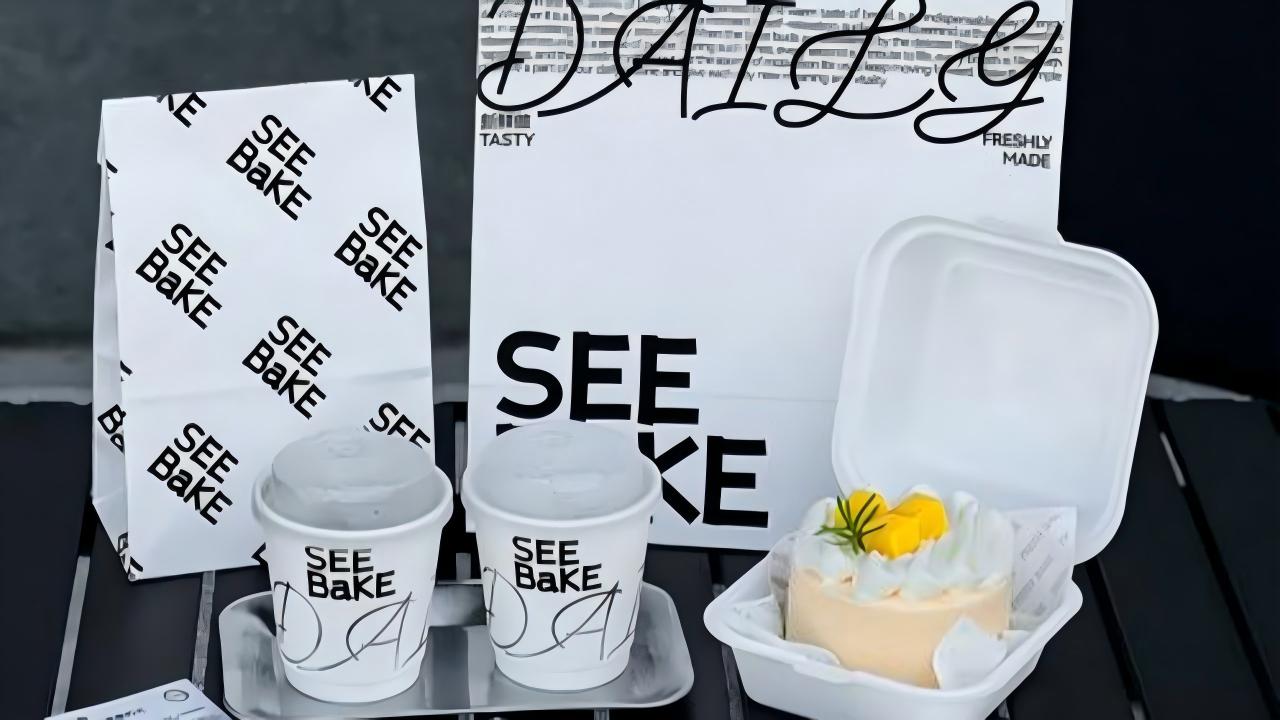
Summer is the season for ice cream, gelato and frozen yoghurt. Ice cream shops, chain dessert shops, street vendors, pre-made ice cream factories and delivery services all have an urgent buying decision to make:
Plastic cups or paper cups. How should they pick? In this article, we will take an exhaustive look at the definitions, benefits and drawbacks, suitable scenarios and purchasing solutions for these two types of containers . It also overviews the common questions raised by industry professionals, covering different pain points of dessert shop, factory, street vendor and foreign trade wholesaler.
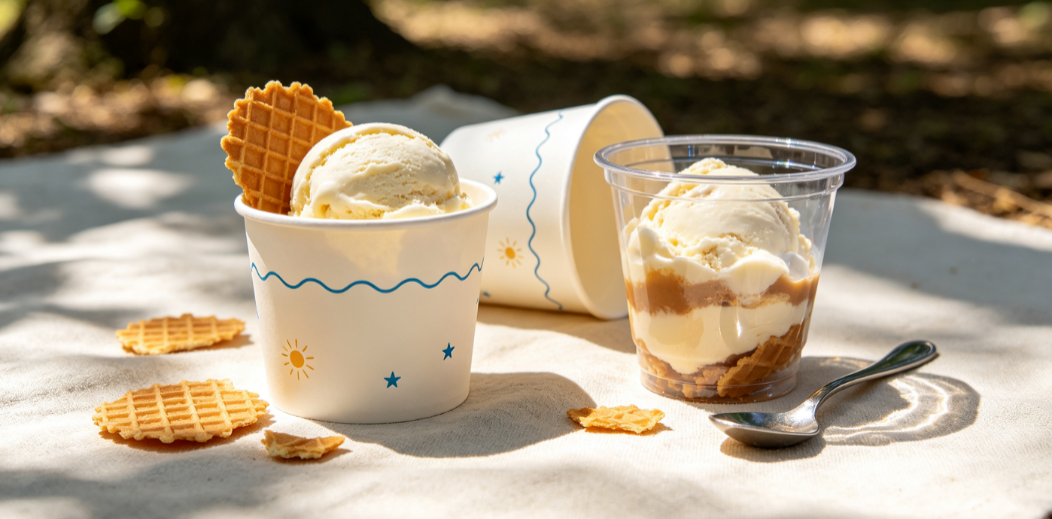
1. What is a paper ice cream cup?
1.1 Fundamental Definitions
The base material of paper ice cream cups is food-grade thickened white cardboard, and the inner wall is coated with PE coating or PLA biodegradable coating. Specifically designed for sub-zero low temperature environments to optimise the stiffness and water resistance. Regular hot beverage paper cups tend to soften and break when used to hold ice cream for a long period.
( 1 ) PE coated paper cups: high cost performance, waterproof and oil-proof, stable, full-color printing, recyclable, suitable for domestic offline stores and street stalls, complete specifications, can be equipped with various cup lids.
(2) PLA Biodegradable paper cups: The inner wall is applied with corn starch, which has passed the European and American composting certification. It is 100% degraded in 180 days in industrial composting, which complies with the overseas plastic restriction regulations, and is suitable for foreign trade, high-end cultural and creative industries and organic dessert shops.
The paper cups are LOGO customisable, hot stamping, seasonal patterns and paper spoons and wooden spoons. These may be used for ice cream, pudding, fruit salad, small portions of salad and many other uses.
1.2 Two main materials
( 1 ) The inner side of the PE coated paper cup
is coated with polyethylene waterproof coating, cost-effective, good waterproof and oil-proof effect, can be printed in full colour with customised logos and patterns, and can be recycled. Suitable for domestic stores, street stalls, small and medium-sized dessert shops, etc. The sizes range from 3 ounces to 16 ounces and can be combined with paper lids and transparent arched lids. It is the brand’s flagship product.
( 2) The inner coating of the PLA biodegradable eco-friendly paper cup
made from corn starch and does not contain petroleum-based plastics. This product is certified compostable according to ASTM D6400 in the U.S. and EN13432 in the European Union. And it can be fully degraded in 180 days in the industrial composting environment, with no white pollution. It meets the plastic limit standards of Europe, the United States and Australia and is widely used in foreign trade exports, high-end organic desserts, popular zero-waste brands and cultural and creative ice cream projects in scenic spots.
1.3 Supporting Facilities and Applications
Customise paper ice cream cups with full-color printing and gold foil stamping, so your brand logo and limited-edition holiday designs print directly on the cup. We have a large selection of lids available from flat paper lids to transparent arched lids and leakproof sealing lids. Paper or wooden spoons finish serving for dine-in, takeaway and delivery too. They can be used for frozen yoghurt, pudding, milkshakes, fruit salads and small light salads – one cup can do many desserts, which is very practical apart from ice cream.
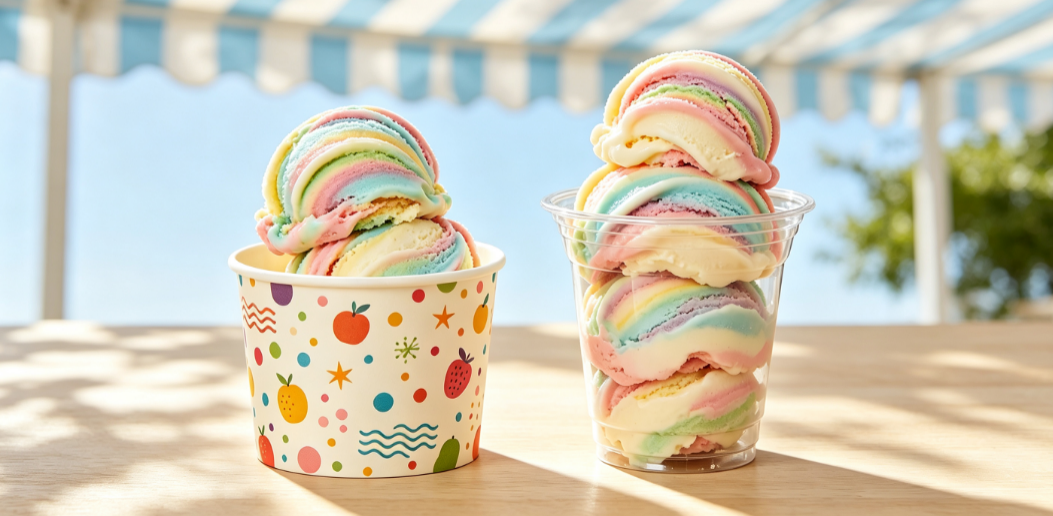
2. What is a plastic ice cream cup made of?
2.1 Some Basic Definitions
Plastic ice cream cups are manufactured using injection moulding and thermoforming processes from petroleum-based plastic granules. Mainstream materials in the industry are mainly divided into three categories: PP (polypropylene), PET (polyester) and PS (polystyrene). They are made of a thick plastic that is resistant to water and cold and they are transparent so you can see the layers of ice cream, cream and fruit. They are the classic containers for pre-made ice cream and favourite treats.
2.2 Detailed Description of the Three Plastics
( 1 ) PET clear plastic cup ( market mainstream )
is highly transparent, thin, tough and has a great display of screen. Suitable for online celebrities to take photos and high value takeaway products. The maximum temperature resistance is 70℃, only suitable for cold drinks. It is used mainly to hold fresh ice cream in stores, and is somewhat brittle when stored at low temperature for a long time.
( 2 ) PP Polypropylene plastic cups (for precast plants)
have very good low-temperature resistance, and can be stored for a long time in the cold chain of -30 ℃ without cracking. They are chemically stable, they will not react with dairy products or fruit acids, they do not have a plastic smell, so they are the material of choice for large-scale prefabrication of tub ice cream. The plastic cups can be slightly microwaved, they have good sealing properties and can effectively prevent the frosting and spoiling of ice cream.
( 3 ) PS foam cups (phased out gradually)
They have the lowest purchase cost and good heat preservation effect, but they are not recyclable, difficult to biodegrade naturally, and have the risk of microplastic leaching. They are prohibited in Hainan, Zhejiang, Shanghai and many countries in Europe and America. Currently, only a few low-end merchants are still using them, and it is not recommended to buy them for a long time.
2.3 Preliminary reminder of basic defects of plastic cups
Petroleum-based single-use plastics take 200-500 years to degrade naturally and when littered, they pollute water and soil. In many countries around the world, there are restrictions on plastic products, limiting the circulation of single-use non-degradable plastic beverage cups, and export orders are easily stalled due to material issues. That is the main reason why paper cups are being turned to by many companies.
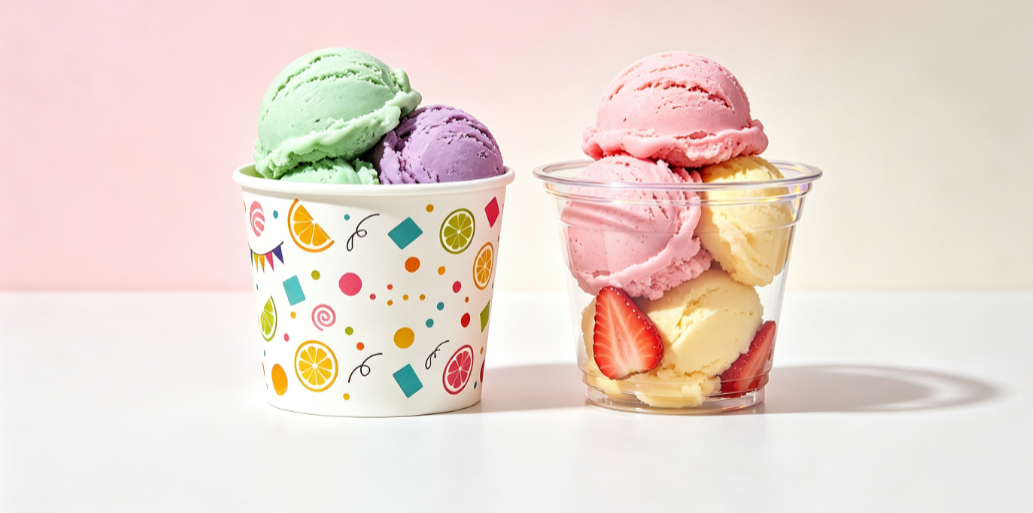
3. Pros and Cons of Paper Ice Cream Cups
3.1 Major Benefits
( 1 ) Eco-friendly and adhering to the policies for global restriction of plastics.
Ordinary PE paper cups are recyclable. PLA biodegradable paper cups have a full set of European and American export environmental certifications and can be circulated normally in countries that prohibit the use of disposable plastic cups. You don’t have to worry about being seized by foreign trade merchants. Since the paper packaging recycling system is mature, it is the first choice for chain stores and scenic spot brands to build a green image. Young consumers are more willing to pay for environmentally friendly packaging and increase the brand repurchase rate. All Haoke Pack’s biodegradable paper cups are export qualified, solving foreign trade compliance problems in one stop.
( 2 ) Flexible printing customisation, differentiated brand and low cost.
Paper fibre adhesion is strong, can support four-color printing on a full page, gradient illustrations, logos, slogans, hot stamping, hot stamping, etc., delicate and full of colours. Transparent plastic cups can only be attached with self-adhesive labels, which are easy to fall off when wet, and the printing cost is higher; paper cups do not need additional stickers, printing is completed in one go, unit price is lower for bulk customisation. Customers can take photos with customised paper cups from brand stores, thus providing free outdoor advertising. Startups are able to purchase small quantities of samples to test out the sales without having large inventories.
( 3 ) The insulation can avoid frostbite on the hands and improve the customer experience.
Plastic is a good heat conductor. When ice cream is held at -18℃, the cup is cold and a lot of water droplets condense on the outer wall, which easily wet the customer’s clothes and bags, resulting in frequent negative reviews. The paper cups use a natural fibre insulation layer, which has a mild heat retention effect, is not easy to condense water droplets, and has a soft texture, which is more suitable for the elderly and for children.
(4) Applicable to various offline scenarios like markets, scenic spots,
and street markets. Paper cups are lightweight and stackable, making them a perfect choice for amusement parks, camping, nite markets, and scenic spot activities. Easy garbage sorting after use. No need for separate plastic recycling bins. Convenient site cleaning. Special coloured printed paper cups with creative ice cream create stronger atmosphere and give more quality to the product.
( 5 ) Reduced risk of food safety issues, no microplastic risks.
All of the products are made of the food grade paper, coating standards. Only the inner wall is touched by food. Microplastic molecules do not leach out of the product even under high or low temperature conditions. Mothers, infants and children like paper containers. The paper cups in stores can relieve parents’ concerns. These products are free of fluorescent agents and harmful inks and have passed the U.S. food contact tests. Food and Drug Administration (FDA)
( 6 ) Multi-category applicability eases inventory pressure.
A paper cup can hold many products, such as ice cream, frozen yoghurt, salad, iced porridge and popcorn. Merchants do not have to buy a lot of different plastic containers. This reduces the number of inventory types and makes warehouse management easier.
3.2 Disadvantages of paper ice cream cup
( 1 ) Smaller long term frozen storage capacity than PP plastic cups.
Fresh production and sales and short-term storage within 3 days are suitable for ordinary PE coated paper cups. If the prefabrication plant has to freeze for 1-3 months, long-term low temperature will lead to ageing of the coating and softening of the body of the cup, resulting in water leakage. The solution is to use double-layer thickened special paper drums for freezing and high-density PLA coating, which can meet the short-term inventory needs of small and medium-sized factories.
(2) The lack of transparent display effect and visual appeal.
Paper cups are opaque, so you can’t see the layers of ice cream and pieces of fruit directly. PET plastic cups are not good for the visual effect of shops that focus on high-value trendy desserts. This can be compensated by pairing them with transparent arched cup lids, considering the environmental protection and display effect.
( 3 ) Paper cups easily deform and absorb moisture in a humid environment.
In the south during the plum rain season and warehouses with high humidity, paper cups may get soft if placed outdoors and should be kept dry.Plastic cups are not affected by humid air and have a higher tolerance for storage errors.
(4) The unit cost of one thickened PET cup is higher than that of
a normal PET plastic cup. The price of bulk purchase of thin PET plastic cups is low and the short-term packaging cost is also low, so it is suitable for street vendors with low prices. Paper cups can, however, increase product premium, decrease customer complaints, and are more suitable for foreign trade exports, so they will bring better long-term comprehensive benefits.
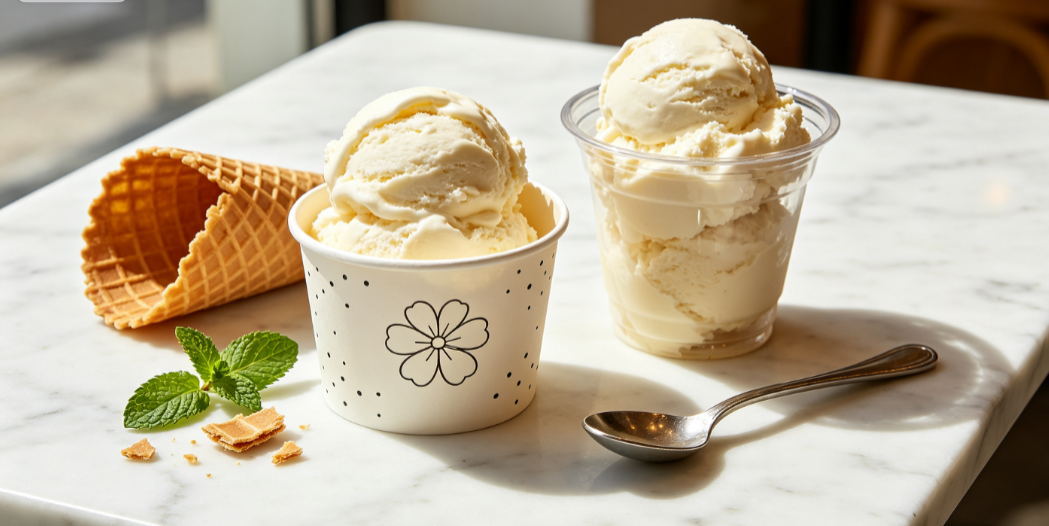
4. Advantages and disadvantages of plastic cups for ice cream
4.1 Key Benefits
( 1 ) Desserts are presented in a very eye-catching way, totally transparent and well visible. PET The plastic is fully transparent and ingredients like cream, jam, nuts and fruits are clearly visible, creating a strong visual impact. It is suitable for online food delivery and short video promotion. It is the core packaging for creating hot-selling products.
( 2 ) Cold resistance, sealed storage, suitable for industrial pre-production. PP
The material has the best freeze resistance in the industry, and can be frozen at -30℃ for 3-6 months without cracking or leaking. Its good sealing performance can effectively isolate air, prevent ice cream from dry and frosting. All pre-packaged products are packaged in PP plastic containers by the large ice cream factories and supermarkets that have been frozen.
(3) Sturdy and durable, with high drop resistance and low damage rate in logistics
. The plastic material is tough and not easily damaged by squeezing or slight drops, thus reducing the loss during large-scale long-distance cold chain transportation. Paper cups are prone to curling, water seepage and breakage when stacked too high or subjected to violent logistics transportation, increasing the logistics loss costs.
( 4 ) Humid environments do not affect storage.
Plastic does not absorb water and will not soften or deform even when stored in a simple warehouse or during rainy season in the south. It require no temperature and humidity control for storage, and have low management threshold.
(5) The basic ultra thin PET cup is low in unit price and suitable for low cost,
market of made-to-order small-volume PET plastic cups. It is very suitable for nite markets to attract customers with low prices and for self-service dessert shops to control packaging expenses. It can save a lot of money in the short term.
4.2 Cons
(1) High policy compliance risk. Plastic products are regulated in many countries and many places.
In China, provinces such as Hainan, Zhejiang and Guangdong have prohibited the use of non-degradable disposable plastic catering containers and many countries in Europe, America, Australia and Southeast Asia have also restricted the import of PET and PS plastic beverage cups. Foreign trade orders are subject to goods being detained and fined. Pure plastic packaging is ruled out straight away when bidding by overseas brands. A lot of foreign trade merchants have turned to use biodegradable paper cups to avoid risk.
( 2 ) The problems of cold hands and running water are very apparent, resulting in
a large number of adverse reviews for the shop. Plastic conducts heat fast, so when the cup is full of ice cream, it will get cold, and a lot of water vapour will easily condense on the outer wall, which can easily dirty your phone and clothes. The high proportion of ‘dripping cup’ in the negative reviews of takeaway directly reduces the store rating and the willingness of repeated customers to buy.
( 3 ) Custom printing effect is poor and brand awareness is low.
You can only use clear plastic to attach self adhesive labels and the labels will bubble and fall off from condensation. Custom pattern technology is expensive and limited. Existing plastic dessert cups serious homogenisation of appearance, it is difficult to form a unique brand visual memory.
( 4 ) Food-grade PET is limited
suitable for short term storage of cold drinks. Cold dairy products and acidic sauces can leach microplastics in trace amounts during prolonged exposure to the elements. Exposure to sunlight exacerbates the release of harmful substances. Stores catering to the mother and baby and health markets in general have stopped using plastic cups.
(5) It is difficult to recycle these wastes, which harms the environmental image of the brand.
The PET and PS plastic cups stained with milk and sauce cannot enter the regular recycling channels and can only be landfilled. It takes hundreds of years to degrade, which could make the brand lose the young consumers that value sustainable consumption.
5. Paper ice cream cups and plastic ice cream cups application scenarios comparison
5.1 Top ways to use paper ice cream cups
( 1 ) Chain ice cream shops and boutique Italian ice cream shops : pay attention to dine-in and on-site sales , pay attention to brand image and customer experience , use coloured paper cups to improve the quality of the shop , avoid cold hands and water droplet problems , and establish a green and healthy positioning .
( 2 ) Scenic area cultural and creative products, amusement parks, camping markets and nite markets: They have their own photo-taking attributes, customised IP patterns improve the high-end nature of the products, outdoor garbage disposal is convenient, they meet the environmental protection management requirements of scenic areas, and are not subject to plastic restriction orders.
( 3 ) Foreign trade wholesalers and cross-border dessert brands : Priority supply rights of PLA biodegradable paper cups to countries with restrictions on plastic exports , and a full set of international certifications to ensure smooth customs clearance . The manufacturer offers one-stop foreign trade packaging solutions.
( 4 ) High-end yoghurt shops and maternal and infant dessert shops: They advocate the concept of plastic-free health, solve the worries of parents about food safety, and have a higher acceptance rate in the target customer group.
( 5 ) Company tea breaks , birthday parties and campus events : Colourful paper cups create a lively scene , are disposable , do not need to be washed , and are easy to sort . Therefore , they are the first choice for event organisers .
( 5 ) Comprehensive light meal and fruit salad takeaway stores: applicable to multiple categories, unified brand packaging visual effect, and improved takeaway product quality.
5.2 Plastic Ice Cream Cups Suitable Situations
(1) Large-scale pre-made ice cream factories and supermarket frozen boxed products: Require long-term frozen storage and long-distance cold chain transportation. PP plastic is irreplaceable in terms of resistance to freezing and keeping freshness.
(2) Online dessert shops for online celebrity customers:Take high-quality layered photos and show the filling in a transparent PET cup to the maximum extent to improve the order conversion rate.
3) Small shops attract customers with low-price self-service and street stalls: costs for packaging are very low, only local short-term low-price traffic business is done, no foreign trade or long-term brand planning is performed.
( 4 ) Home short-term frozen desserts : sealed and shock resistant , high resistance to frequent handling and storage .
6. Merchant Procurement Selection Guide
We combine five dimensions: sales channels, brand positioning, warehousing cycle, budget, and warehousing and logistics, to provide standardised procurement solutions.
6.1 Sales Channels: Domestic Sales / Foreign Trade
( 1 ) Foreign trade merchants: Select PLA biodegradable paper cups directly to prevent the import ban of plastics in various countries. The manufacturer has a full set of customs clearance qualifications and supports multilingual packaging customisation;
( 2 ) Stores in the area
Chain stores and shops in tourist areas (mid-to-high-end): Customised paper cups with thickened PE coating to enhance brand image;
Popular online food delivery services use PET plastic cups or paper cups with domed lids as a compromise.
Frozen pre-made plant Mainly PP plastic buckets, thickened paper cups for tasting new products.
6.2 Positioning of brand and target audience
(1) High-end, organic, parent-child, cultural and creative brands: paper cups are the best choice, and can achieve a product premium of 2-5 yuan to offset the difference in packaging price;
( 2 ) Low-cost street stalls and self-service stores: Basic PET plastic cups to deal with the upgrading of plastic restriction policies in the short term, and stock up on paper cups;
( 3 ) Online and offline store balance: online can use PET plastic cups to produce popular products with beautiful appearance, offline can use uniform printing paper cups to serve diners.
6.3 Product Storage Cycle
(1) Sold out in 3 days and made to order: This is just right for standard thick paper cups;
( 2 ) Frozen storage over 1 month: PP plastic drums are the main type. Double-layer frozen paper drums can be selected to meet the needs of short-term storage.
6.4 Budgeting and Long-Term Cost Planning
Most companies compare only unit prices, ignoring the hidden costs of plastic cups: customer churn and negative reviews, losses from export withholding taxes, sticker printing costs and damage to brand image. But paper cups offer long term benefits like better product premium, free advertising of brands, compliance with export rules and stable repurchase rates in return. They can create small batches of samples without the need to stock huge amounts or lock up large amounts of capital.
6.5 Conditions of Warehousing and Logistics
(1) Dry warehouse, short distance transportation, short term storage: paper cups have high compatibility, are light and easy to stack;
( 2 ) Plastic cups have a lower rate of breaking in damp warehouses, large-scale long-distance cold chains and frequent handling. Paper cups can be used with cushioning packaging to reduce losses.
Conclusion:
Paper cups are more environmentally friendly, offer a better customer experience and more brand customisation than plastic cups, making them ideal for export, chain stores and tourist attractions. Choose a manufacturer that has a good reputation.haokelao – 20 years of manufacturing experience, complete international certifications, supports PLA degradation and full colour customisation, complete accessories, free samples, 24-hour quotations. Turn paper cups into a value proposition for your brand.
FAQ
1. PLA biodegradable paper cups vs PE coated paper cups What’s the difference?
PE coating has high cost-effectiveness and waterproof stability, but it is not completely biodegradable; PLA coating is made from corn starch and can be completely degraded in 180 days thru industrial composting, meeting European and American export environmental certifications.
2.How long do you keep paper ice cream cups in the freezer?
Regular PE coated paper cups are suitable for short-term storage (sold within 3 days), and for frozen storage exceeding 1 month, PP plastic buckets or double-layered paper cups specifically for freezing are recommended.
3.So which is better insulator, a paper or plastic cup?
Double-walled paper cups have better cold-keeping performance than ordinary plastic cups, Some brands of paper cups have nearly three times the heat insulation performance of plastic cups, and reduce condensation by more than 40%.
4.Why do paper cups cost more than plastic ones?
The cost of the raw materials of paper cups is 30%-50% higher than that of plastic cups of the same size, mainly due to the pulp and coating layers; but paper cups can enhance brand premium, reduce customer complaints, and have better overall long-term benefits.
5.Can you microwave paper ice cream cups?
No. Most paper cups are coated with PE or PLA on the inner wall, which is not suitable for microwave heating. If microwave heating is required, it is recommended to use PP plastic cups (can be slightly microwaved).
6.Are plastic ice cream cups recyclable?
PET and PS plastic cups contaminated with residues of dairy products are difficult to enter into regular recycling channels and are mostly landfilled or incinerated, which is one of the reasons why many countries and regions restrict single-use plastic cups.
About The Author:
Jason Fu
Hi, I’m Jason Fu, General Manager, Marketing Director, and SEO Expert at Haokelao. With over 20 years in the paper food packaging industry, I bring deep expertise in export trade and a strong passion for SEO and marketing. Whether your questions are about paper food packaging products, or marketing strategies, I’m here to help and exchange ideas. Let’s connect!